You got into the habit of putting meeting notes in Notion. They pile up nicely. Then a quarterly review comes around, you need to find when a particular decision was made and why, and you lose an hour digging. Letting Claude or ChatGPT read your Notion workspace sounds like the fix, so you started looking into Notion MCP.
Usually that is not a misconfiguration. It is a plan requirement. This guide checks those conditions first, using Notion's own documentation, and then walks through setup. It assumes you already keep notes in Notion, so if you are just getting started with Notion the reasoning will not map cleanly.
The 30-second version
https://mcp.notion.com/mcp, and Claude, ChatGPT, and Cursor all connect to that same URL. The catch is that the dedicated meeting-notes tool, notion-query-meeting-notes, is documented as requiring a Business plan or higher with Notion AI. And the thing to settle before any of it: MCP can only read what is already in Notion. If your notes are not accumulating there, connecting gives the model nothing to read.| Item | Where it lands |
|---|---|
| Endpoint | https://mcp.notion.com/mcp (Streamable HTTP, with SSE as an alternative) |
| Clients | Claude (Desktop and claude.ai), ChatGPT Pro, Cursor, any MCP-capable app |
| Meeting notes tool | notion-query-meeting-notes requires a Business plan or higher with Notion AI |
| Permissions | Runs with the full Notion permissions of whoever connected |
| The real prerequisite | Notes must already exist in Notion as text |
Check the plan requirements first
Most guides open with setup steps. This one flips the order, because without knowing these conditions you can spend a long time debugging something that was never going to work on your plan.
The meeting-notes tool needs Business plus Notion AI
notion-query-meeting-notes, described as a way to "query the current user's meeting notes, filtering by meeting-specific properties (such as a title keyword search)."The condition attached to it is worded in a way that is easy to misread, so here it is verbatim:
Available on all plans, but using it requires a Business plan or higher with Notion AI.
The tool shows up in the tool list on every plan, which makes it look available. Calling it is what surfaces the requirement. If you read a guide that lists this under "what you can do" and then hit a wall, this is almost always why.
Whether upgrading is worth it is a separate question, and one worth doing the math on before you commit.
Search narrows without Notion AI
notion-search, documented as searching "across your Notion workspace and connected tools like Slack, Google Drive, and Jira." The condition follows immediately:Requires Notion AI access. Without a Notion AI plan, search is limited to your Notion workspace only.
So without Notion AI you lose the cross-tool reach into Slack and Drive, but you keep search inside Notion. For finding meeting notes that already live in Notion, that is usually enough.
Some tools carry no plan condition at all
This is the part worth not giving up over.
notion-fetch retrieves content from a page, database, or data source by URL or ID, with no plan condition documented. notion-query-data-sources runs SQL or an existing view against your databases and returns grouped, filtered results with counts and rollups, also with no condition documented.If you have designed your own meeting-notes database, those two are enough to work with. Arguably they give you more control than the purpose-built tool: when date, attendees, and decisions live in properties you defined, you can query them precisely.
| Tool | What it does | Plan condition |
|---|---|---|
notion-query-meeting-notes | Filters meeting notes by meeting-specific properties | Business or higher, with Notion AI |
notion-search | Searches Notion plus connected tools | Notion-only without Notion AI |
notion-fetch | Retrieves a page, database, or data source | None documented |
notion-query-data-sources | Queries databases with SQL or a saved view | None documented |
notion-create-pages / notion-update-page | Creates and updates pages | None documented |
notion-create-comment / notion-get-comments | Adds and reads comments | None documented |
What Notion MCP can do
Twenty-two tools, six that matter here
The official reference lists 22 tools: search and fetch, page create, update, move, and duplicate, database and view creation, comments, teamspace and member listing, and async task status.
notion-convert-page-to-skill for marking a page as an AI skill, so do not read the length of the list as breadth of relevance.There is a gap the API cannot reach but MCP can
Worth separating clearly, because these get conflated.
So the API and MCP are not two names for the same thing. They reach different places. Write code for scheduled jobs and system-to-system automation with the API; use MCP when you want a model reading and reasoning over your workspace conversationally.
File handling has hard limits
Some guides state that Notion MCP does not support image or file uploads. The current tool reference shows support with specific ceilings:
notion-create-file-uploadgenerates a short-lived upload URL, capped at 20 MiBnotion-create-attachmentbuilds an attachment from text, an HTTPS URL, or an uploaded file, capped at 200 KiB inline, and URL fetches at 5 MiB on free plans, 50 MiB on paid
Connecting
One endpoint
https://mcp.notion.com/mcp, with https://mcp.notion.com/sse available as an alternative.Authentication is OAuth, and the interactive flow is currently required. Non-interactive auth is not supported, so unattended server-side usage is off the table for now.
Claude Code
Run this in your terminal:
claude mcp add --transport http notion https://mcp.notion.com/mcp
/mcp command. Scope options are local (the default), project, and user. For personal use the default is fine.ChatGPT
Open Settings on chatgpt.com, go to Connectors, choose Add Connector, enter the same URL, and complete OAuth. Notion's help documentation lists ChatGPT Pro as the supported tier.
Cursor
Go to Settings, then MCP, then Add new global MCP server, and paste:
{
  "mcpServers": {
    "notion": {
      "url": "https://mcp.notion.com/mcp"
    }
  }
}
Save, restart, and complete OAuth the first time you use it.
Hosted versus the open-source server
notion-mcp-server as well. Notion's own docs note that it is no longer actively maintained. It does support bearer token auth, which the hosted server does not, but for a new setup the hosted version is the safer default.The permission model, before you connect
It runs with your full permissions
Notion's help documentation puts it directly: MCP tools operate with your complete Notion permissions and can reach everything you can reach.
Convenience and exposure come from the same mechanism here. If there are HR notes or draft performance reviews you can open, the model can read them too. Worth a look at what your own account can actually see before you connect anything.
Admin control over which AI apps are allowed is Enterprise-only
On other plans there is no mechanism stopping individual members from connecting the workspace to whatever AI app they like, under their own permissions. Workspace owners can list and revoke connections through the admin API, so the gap gets covered by policy and periodic review rather than by enforcement.
Disconnecting is all-or-nothing
A current limitation: you cannot disconnect an individual user from a specific tool. The available action is disconnecting all users, after which anyone who still needs access re-authenticates. Because backing out is coarse, decide your scope before you roll it out.
The real prerequisite: MCP only reads what is in Notion
Everything above is conditions and setup. This is the part that actually determines whether it works for you.
How this usually fails
- Note-taking rotates between people, so some meetings have a record and some do not
- Recordings exist, but nothing turned them into text, so there is nothing to read
- Text exists, but dates and decisions are buried in prose with no properties to filter on
What the content needs
Three things, if a model is going to be useful against it:
- It is text in Notion. Video alone is unreadable to the model
- It has consistent structure. Date, attendees, and decisions live in properties
- It arrives automatically after every meeting. Manual entry starts slipping during busy weeks
The third is the hard one in practice, because the meetings you go looking for later are usually the ones from the weeks you were busiest.
Automating the supply side with Qureco
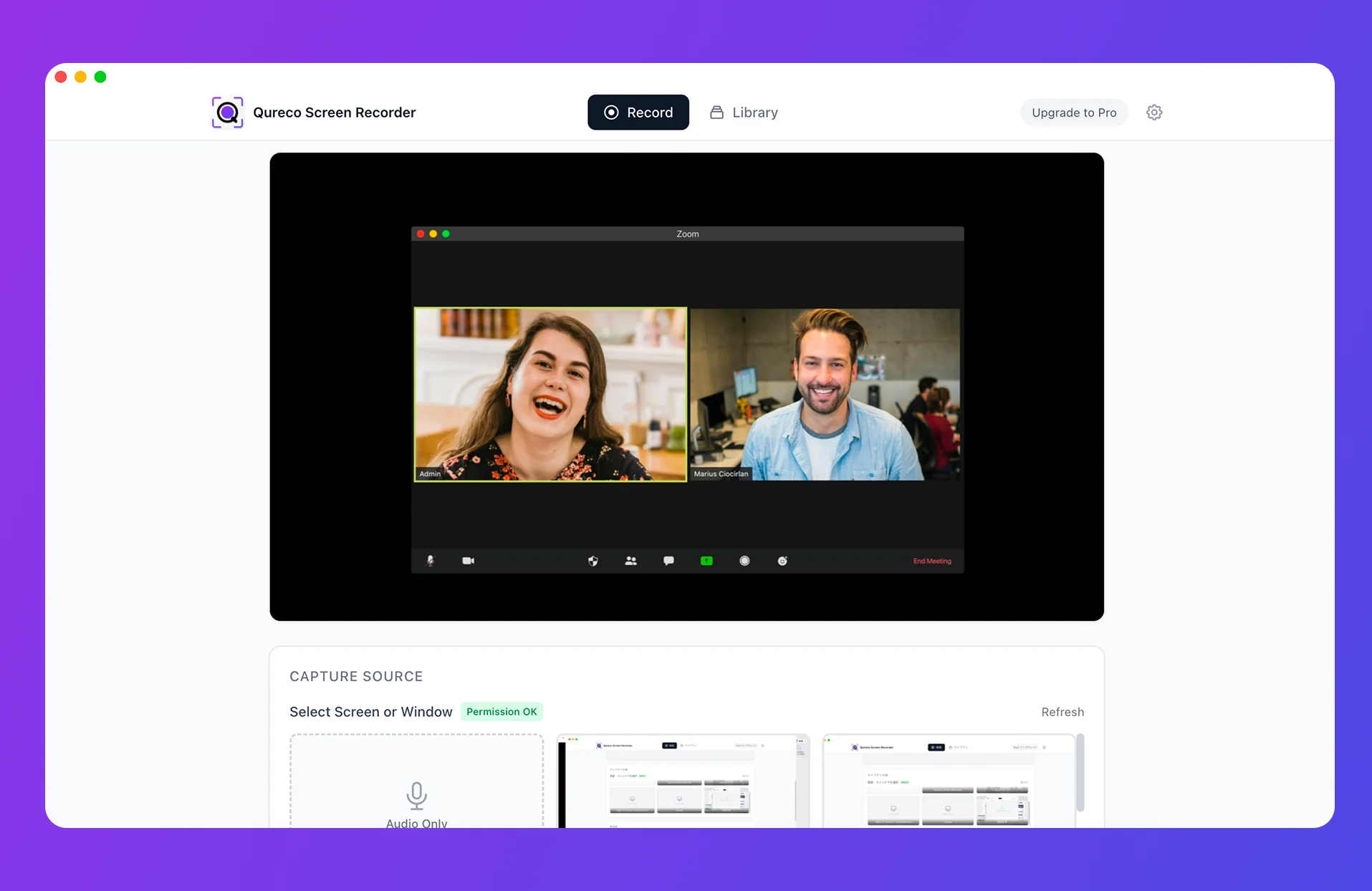
Qureco is a screen recorder for Mac. Record a meeting and, on the Pro plan, AI generates the notes from that recording and sends them to Notion. Text keeps accumulating without anyone having to remember to write it up.
The way it handles recordings lines up with those upload limits too. The video stays in cloud storage and Notion gets the transcript plus a link to the recording. No bot joins the call, which makes it workable for client conversations where getting consent for a bot is awkward.
Recording is free with no time limit and no watermark. The Pro plan, which includes AI meeting notes and the Notion integration, is $9 per month or $81 per year, with the first two weeks free and no credit card required.
Frequently asked questions
Does Notion MCP work on the free plan?
notion-query-meeting-notes requires a Business plan or higher with Notion AI, and notion-search is limited to Notion itself without Notion AI. Since notion-fetch and notion-query-data-sources carry no documented plan condition, querying a database you built yourself does work on the free plan.Meeting note search is not returning anything
notion-query-meeting-notes, it will not run without a Business plan and Notion AI. If you meet that, look at the content next: is the note text actually in Notion, and are there properties like date or attendees to filter on?Should I use the Notion API or MCP?
Use the API when you are writing code for scheduled jobs or integrations with other systems. Use MCP when you want a model reading and reasoning over the workspace. They also reach different places, since Notion AI Meeting Notes transcripts are unavailable through the API but accessible through MCP. Running both is fine.
Can I upload meeting recordings to Notion?
Not realistically. The upload URL is capped at 20 MiB, and a one-hour recording is far past that. Keep video in cloud storage and put a link in Notion.
Claude or ChatGPT?
Both connect to the same endpoint, so capability is largely the same. Use whichever you already work in. Notion's help documentation lists Claude (Desktop and claude.ai), ChatGPT Pro, and Cursor.
Can I exclude pages I do not want the model reading?
Since MCP runs with the connecting user's permissions, permissions are the lever. Remove view access from the account you connect, or keep sensitive material in a separate workspace or private pages. Per-app allowlisting is an Enterprise admin feature.
Terms used in this article
| Term | Meaning |
|---|---|
| MCP (Model Context Protocol) | A shared spec for giving models access to external tools and data |
| Hosted MCP server | An MCP server operated by the provider, so you do not run one yourself |
| OAuth | Granting access to a service without handing over your password |
| Streamable HTTP | One of MCP's transports, and the one Notion recommends |
| Notion AI | Notion's paid AI capability, which some MCP tools depend on |
| Data source | The unit representing a Notion database's contents, and what queries target |
| MiB | A unit of data size. 20 MiB is roughly 21 megabytes |
Wrapping up
- Setup takes five minutes. One endpoint,
https://mcp.notion.com/mcp, for Claude, ChatGPT, and Cursor alike - The meeting-notes tool has conditions.
notion-query-meeting-notesneeds Business plus Notion AI, andnotion-searchnarrows without Notion AI - Your permissions carry over. Anything you can see, the model can see. App-level allowlisting is Enterprise-only
- No content, no results. MCP reads only what is in Notion, so getting notes to accumulate automatically comes first
Building up the content before you connect makes for a very different first experience than connecting and then wondering why nothing comes back. Get meeting records landing in Notion on their own, then point Claude or ChatGPT at them.
Qureco Screen Recorder
Powerful screen recording app for Mac
Record meetings, let AI handle the notes, just read what arrives in Notion.
Try all features free for the first two weeks.