You export the quarter's closed-lost deals from your CRM to build the review deck. The reason field is almost entirely "price."
If you take that to your leadership team, the conversation you get back is about discounting. But that is not what the quarter felt like on the ground. Something kept failing to connect, and nobody has put it into words.
Why the lost-reason field fills up with "price"
The person filling it in is the person who lost the deal
Whoever picks from that dropdown just lost the deal an hour ago.
Reporting that your discovery was shallow, or that you never got in front of the decision maker, is a hard thing to type about yourself. If "price" is one of the options, choosing it is the natural move. This is not dishonesty. It is what the structure produces.
"Too expensive" is a symptom, not a cause
If the number itself were the problem, every deal you quoted at that number would be lost. They are not.
"Too expensive" is what a buyer says when the reason to pay never assembled in their head. The price is the last thing to surface. The cause sits somewhere earlier: budget you never asked about, a problem you never sized with them, value that never reached the person who signs. Until you locate that, discounting is the only lever left.
More data does not raise the resolution
It also assumes the underlying records describe what actually happened. Aggregate a hundred self-reported "price" losses and the finding is that price is your problem. All the extra volume does is make that finding look better supported.
What you need is the primary source rather than the processed data. The call itself.
Start with one recording, not a spreadsheet
The first move is pressing play
If you begin by re-classifying every closed-lost deal, the work takes a week to set up and never actually starts.
You do not watch the whole thing. You watch three places
Rewatching a sixty-minute call costs you a morning. Nobody does that twice.
Watch three segments.
| Segment | Length | What it tells you |
|---|---|---|
| First five minutes | 5 min | How discovery opened. Did you start from their situation or from your product? |
| The minutes around your proposal or quote | ~5 min | The temperature of their reaction. Questions, or silence? |
| Last five minutes | 5 min | How the next step got set. Is there a date and an owner? |
At 1.5x speed that is roughly ten minutes of playback. Even with scrubbing to find the right spots, one call takes about twenty minutes.
A transcript will not give you these three places. Transcripts preserve what was said. They lose the pauses, the tone, and the length of the silence where a question should have been. That is usually where the loss lives.
Put it next to a call you won
One lost call on its own tells you nothing, because you have no baseline for what good looked like.
| Lost call alone | Lost call next to a won call | |
|---|---|---|
| What you get | A list of moments that bothered you | The one difference that decided it |
| The conclusion | "I should have been more thorough" | "Budget confirmation came two calls too late" |
| Effect on the next call | You try harder | You change the sequence |
"Be more thorough" is forgotten by the following week. Comparison is what turns a review into a change of procedure.
Five checkpoints for reading a recording
Here are the metrics conversation-intelligence tools measure, translated into things you can judge with your own eyes.
| # | Checkpoint | Where to look | Warning sign |
|---|---|---|---|
| 1 | Customer talk ratio | Whole call | You are talking more than half the time |
| 2 | Budget, authority, timing | First five minutes | None of it comes up until the end |
| 3 | Where they hesitated | Around the proposal | A silence, then a change of subject |
| 4 | How you handled a competitor's name | Around the proposal | You answered with "we're better at" |
| 5 | How the next step got set | Last five minutes | "We'll think it over and get back to you" |
1. Customer talk ratio
You do not need to measure it precisely. Watch the recording and it is obvious. If your mouth is moving more than theirs, the call was a presentation. You moved to the proposal without spending time on their problem, so the proposal is not phrased in their words.
2. Did you ask about budget, authority, and timing?
If you never asked, write down "never asked." That is a completely different finding from "they said it was too expensive."
3. Where they hesitated
This is the part only a recording gives you.
You share the quote. They go quiet for two seconds, then say they will take it back internally. Or they restart a sentence, or change the subject themselves. Those moments hold the objection they chose not to voice: someone internally will push back, they are looking at alternatives, this fiscal year is already committed.
In a transcript this compresses into four words of "take it back internally." Watching the recording, you can see how many seconds came first. Next time you hear that same pause, you can ask right there: "If anything is giving you doubts, I'd rather hear it now." That alone may justify the review.
4. How you handled a competitor's name
Find the moment a competitor gets mentioned and watch what you said next.
Clips like this, shared with the team, work directly as training material.
5. How the next step got set
In the final five minutes, look for a date, the attendees, and who owes what.
A call that closes with "we'll think it over and get in touch" has already handed control to the buyer. The absence of a scheduled next step is itself evidence that the conversation never got warm enough.
Digital Sales Navi lists an agreed next action among the traits of high-probability calls. Of the five checkpoints, this is the one you can judge most mechanically.
Turn what you found into something you will do differently
Write the cause as a verb
Notes taken while watching tend to come out as adjectives. "Discovery was shallow." "The pitch didn't land." Neither tells you what to change.
Rewrite them as verbs.
| How it usually gets written | Rewritten as a verb |
|---|---|
| The price was too high | I put off asking about budget until the third call |
| Discovery was shallow | I assumed the problem instead of asking how they work today |
| It died in procurement | I never asked who signs |
| We lost to a competitor | I didn't offer comparison criteria when their name came up |
A verb can be done or not done on the next call. That is the form in which a review turns into behavior.
One call is a hypothesis. Three is a pattern
What comes out of a single recording may be specific to that deal. Keep it as personal reflection.
Ask the customer only after you have a hypothesis
Loss interviews work, but the order matters.
Walk in with nothing and ask "why did you go with the other vendor," and the buyer, being polite, says something about price. You have collected the same word twice.
Come in with a hypothesis from the recording and the question gets specific: "I've been wondering whether concerns came up internally about who would run this after rollout. Was that part of it?" That gets a real answer. And as noted earlier, the person asking should not be the rep who owned the deal.
Where the recordings come from
Everything above assumes the call was recorded. In practice, this is where most teams stop.
On a call the customer hosts, you do not get a record button
When you join a Zoom or Google Meet link the customer created, recording rights belong to the host. Either the button is missing from your window or it tells you the host has to allow it. That is the design, not a setting you missed.
Recording your own Mac works regardless of who hosts
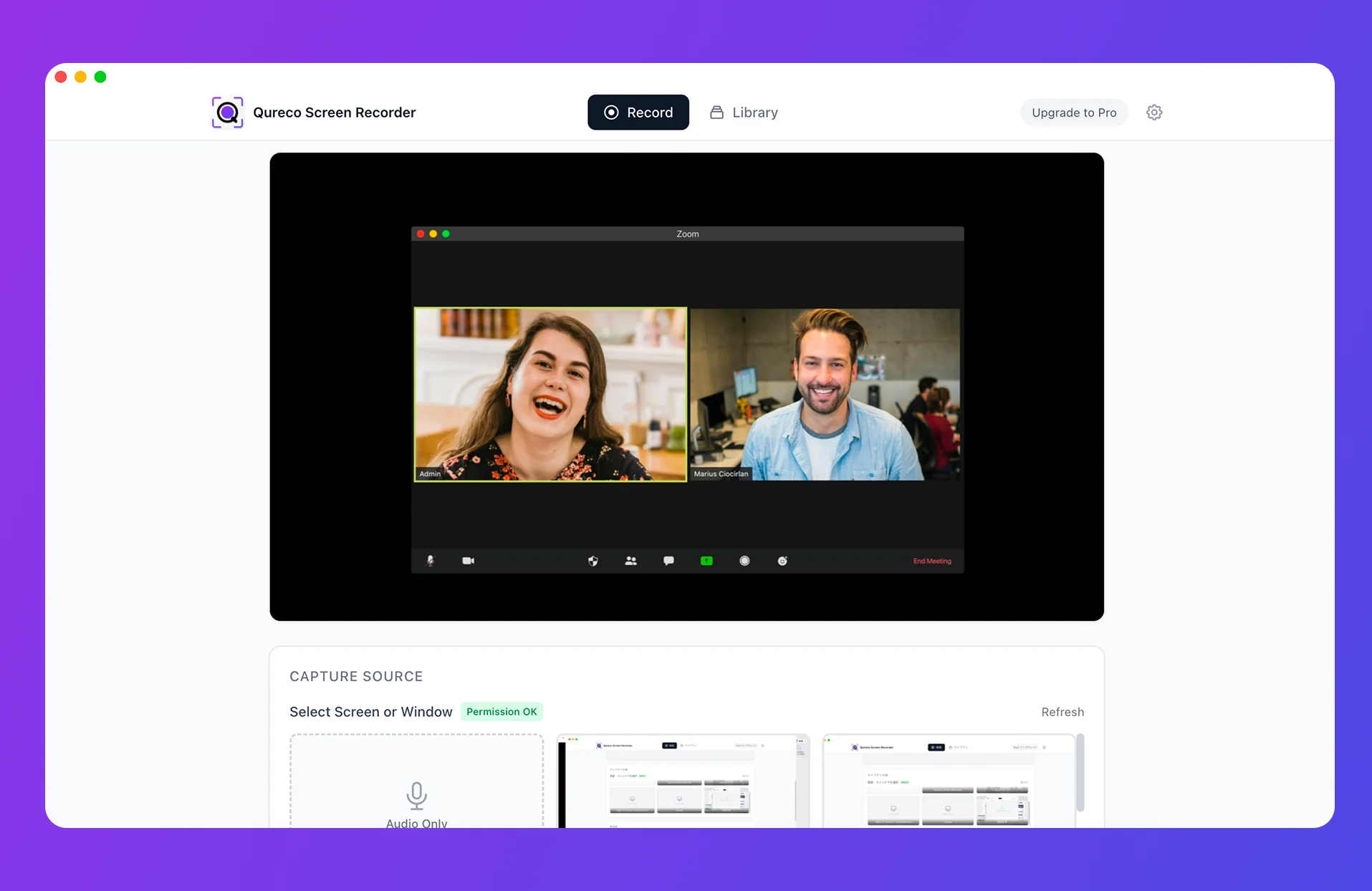
Instead of using the meeting platform's recording feature, you can record your own screen. Host permissions and cloud recording quotas stop mattering. There is also no AI bot to add to the call, so no unfamiliar name appears in the participant list for the customer to ask about.
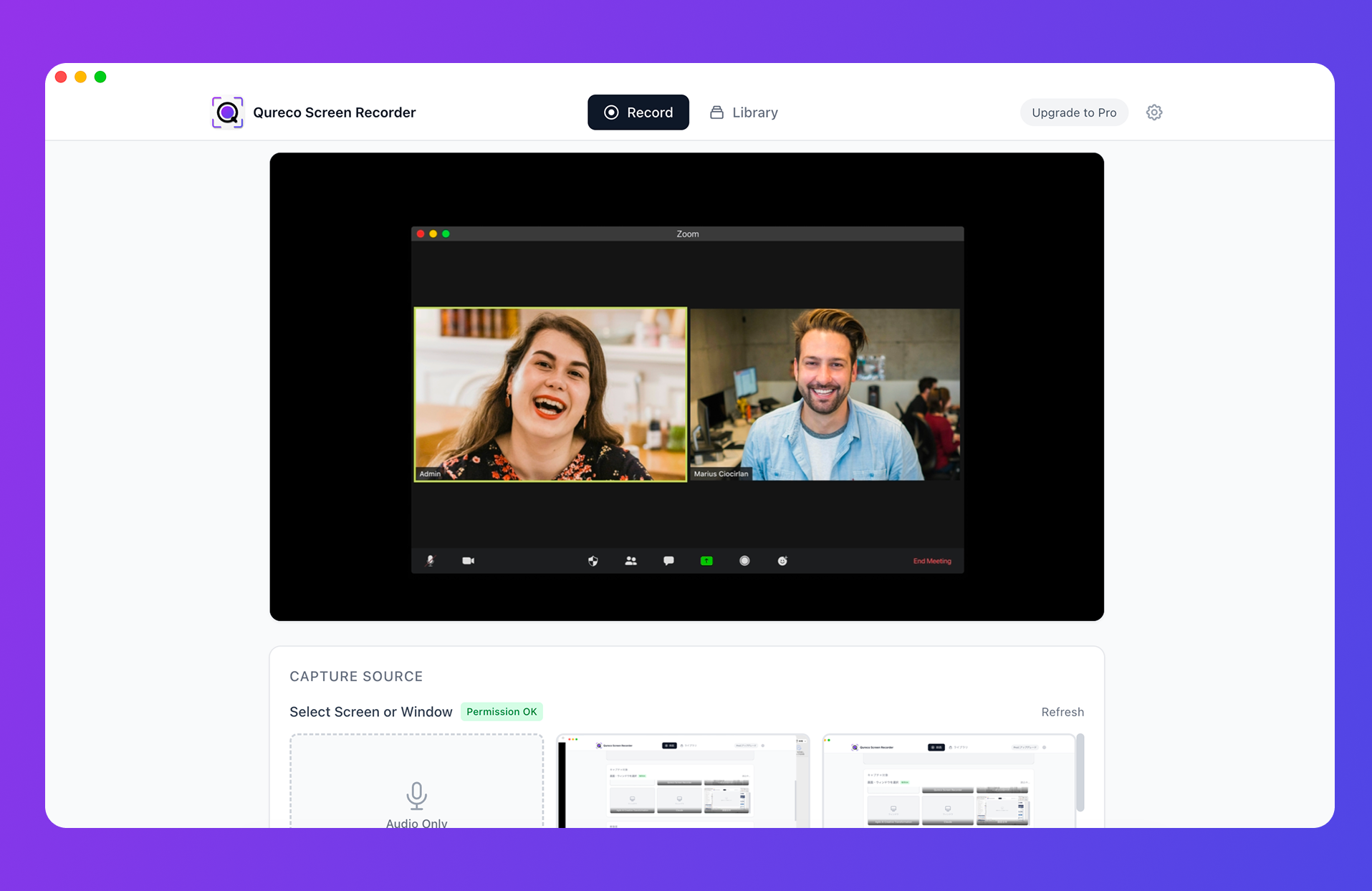
The parts that matter for building a review habit:
- Recording is free and unlimited in length. A sixty or ninety minute call runs to the end, with no watermark
- No virtual audio driver to configure. You capture the customer's voice (system audio) and your own without installing BlackHole or similar
- AI meeting notes generated from the recording (Pro plan), with speaker identification, so you can see who spoke how much
- Notion integration (Pro plan). Collecting notes on a per-deal page makes putting a won call next to a lost one much less work
One caveat: it does not score talk ratio automatically the way a conversation-intelligence platform does. You judge that by watching. For the first several reviews that is arguably better, since you notice more by hand, and you can look at a dedicated tool once you know what you are looking for. Getting the raw material to accumulate comes first.
How to ask for consent
One caveat: tell the other side you are recording. Anything captured silently becomes a different kind of problem the moment you share it internally.
One sentence at the top of the call is enough.
"So I can keep an accurate record of what we discuss, would you mind if I record this call? It's for our internal notes only."
Making it a habit the team keeps
Monthly for distribution, quarterly for depth
The common cadence in win-loss work is a monthly look at loss-reason distribution and month-over-month movement in the sales meeting, with a deeper pass each quarter.
Translated to a recording-based review:
| Cadence | What happens | Time cost |
|---|---|---|
| Weekly | Each rep reviews the three segments of one lost call and writes one verb sentence | 20 min per person |
| Monthly | Line up the sentences and check whether any pattern appears three or more times | 30 min in the meeting |
| Quarterly | For patterns at three or more, compare against won calls and rebuild the play | Half a day |
Twenty minutes per person per week. That is the ceiling for something that survives. Design it as "watch the full recording and present it" and it dies in two weeks.
The order that keeps it from feeling like surveillance
Reviewing your reps' call recordings goes wrong quickly if it reads as a manager hunting for mistakes.
Keep the order:
- Record your own calls first and share your own three segments. Say "I was talking seventy percent of the time" before anyone else has to
- State plainly that this is not used in evaluation. Separate it from performance reviews, and keep repeating that the goal is a repeatable way to win
- Share the good moments first. With the rep's permission, watch a call where someone handled a competitor mention well
The third one does the most work. Once the review is where you get to see how the strong reps operate rather than where you get corrected, reps start volunteering their own recordings.
Keep recordings and notes bundled by deal, not by meeting
A flat list of files by date is unsearchable when you actually want to compare. "Which call was the third one on that deal?" costs five minutes.
With that in place, "open one won deal and one lost deal side by side" takes seconds during the quarterly review.
FAQ
I cannot find time to rewatch calls
Watch the three segments at 1.5x. That is twenty minutes. If even that is out of reach, watch only the last five minutes. Whether a next step was set, across ten lost deals, already shows you a trend.
My reps do not want to be recorded
State that it is not used in evaluation, and start with your own calls. Opening with your own material rather than someone else's mistakes lowers the resistance considerably. If it persists, sharing AI-generated notes before sharing recordings is a reasonable intermediate step.
Should we buy a conversation-intelligence platform?
Automatic talk-ratio measurement and keyword detection are genuinely useful. They also tend to run into the hundreds of dollars per month, and adopting one before your review habit exists leaves you with dashboards and no idea what to change. Review ten calls by hand first. Once your team can name the metrics it cares about, the tool has something to plug into.
How soon after a loss should we review?
Within a week. Recent enough that watching the recording brings back what you were thinking at the time. Skip the same day, though, since the frustration is still fresh and it is harder to watch fairly.
What about in-person meetings?
If you bring your Mac, an audio-only recording supports the same review. You lose faces and reactions to the deck, but talk ratio, whether you covered budget and authority, and how the next step got set are all audible.
Wrap-up
More aggregation of self-reported data returns the same answer it already gave you. Before you aggregate, rewatch one call you lost.
- Watch the first five minutes, the minutes around your proposal, and the last five minutes. Twenty minutes at 1.5x
- Judge on talk ratio, whether you asked about budget and authority, where they hesitated, how you handled a competitor, and how the next step got set
- Write findings as verbs, not adjectives. Not "the price was too high" but "I put off asking about budget until the third call"
- At three occurrences of the same pattern, change the team's play
All of which needs a recording to exist. If the record button never appears because the customer owns the meeting link, recording your own Mac is the fastest way around it. Pick one deal you lost this week and give it twenty minutes.

Qureco Screen Recorder
Powerful screen recording app for Mac
Record meetings, let AI handle the notes, just read what arrives in Notion.
Try all features free for the first two weeks.