Your cursor is hovering over the record button and you have not clicked it. The call starts in three minutes. Will something appear on the other person's screen, and if it does, what will they think of you? So you searched instead.
Two things instead. First, exactly what each of Zoom, Google Meet and Teams shows to the other participants, sourced from the vendors' own documentation. Second, the sentence you can say at the start of the call so that none of this is awkward. For most people, that sentence was the thing they actually needed.
The 30-second version
If you use the recording feature built into Zoom, Meet or Teams, participants see that the call is being recorded. If you use your operating system's screen recorder instead, the meeting platform cannot detect it and nothing is shown. But whether something is displayed and whether you should be recording are two separate questions, and telling people takes about ten seconds.
| How you record | Zoom | Google Meet | Teams |
|---|---|---|---|
| The app's own recording feature | Shown (a consent dialog too, depending on settings) | Shown (cannot be turned off) | Shown (wording varies by org policy) |
| OS screen recording or a third-party app | Not shown | Not shown | Not shown |
| Can you tell if someone else is recording | Yes, for in-app recording | Yes, for in-app recording | Yes, for in-app recording |
What Zoom shows the other participants
In-app recording always notifies, local or cloud
A lot of guides claim that local recording, where the file is saved to your own computer, does not notify anyone. That is not accurate.
Zoom's own support documentation states it plainly:
Zoom will always notify meeting participants that a meeting is being recorded.
Local or cloud makes no difference. The moment you use Zoom's built-in recording, participants see a recording indicator. The confusion comes from articles written years ago that still rank well in search.
Some accounts show a consent dialog
Zoom has a setting called the recording consent disclaimer. When an account owner or admin enables it, participants are asked to explicitly consent before they are recorded, and the wording can be customized per organization.
So depending on the other side's settings, this may go beyond a passive indicator: the other person may have to actively click to agree.
If you are not the host
What Google Meet shows the other participants
Third-party screen recorders are a different matter. Meet has no way to detect them and sends no notification.
What Teams shows the other participants
Starting a recording in Teams displays an in-meeting notice that recording and transcription have begun.
Teams also notifies the organizer, co-organizers and presenters when compliance recording by an external organization is taking place.
OS-level recording is invisible. That does not change anything
Shift+Command+5 on a Mac, the iOS Control Center recorder, and third-party capture apps all run outside the meeting platform. Zoom, Meet and Teams have no mechanism to see them, so nothing is displayed to anyone.
That is a technical fact. This article still does not recommend using it that way.
Legal treatment varies too much by jurisdiction and situation to be useful here, so this article does not go into it. In practice, telling people and then recording is the option that holds up.
How to ask without making it awkward
If you are here because you find it hard to bring up, this section is the point of the article.
There are only three things to say
| What to cover | Example |
|---|---|
| Purpose | Why you are recording. "So I can send you accurate notes afterwards." "So I can focus on the conversation instead of typing." |
| Use | How far it goes. "It won't be used for anything other than the notes." |
| Handling | What happens to it. "I'll delete the recording once the notes are written." "It won't be shared outside this call." |
Saying it at the start of a call
"I'd like to send you accurate notes from today, so would it be alright if I record? It won't be used for anything else, and I'll delete the recording once the notes are done."
It looks long written down. Out loud it takes about ten seconds, and it removes essentially all of the hesitation on the other side.
Putting it in the invite or a pre-meeting email
"I plan to record our call so I can put together accurate notes. The recording won't be used for any other purpose. If that doesn't work for you, just let me know beforehand."
Saying it in advance gives people time to think about it, and sales teams consistently report higher acceptance this way than asking cold at the top of the call.
One line in chat
For internal standups and recurring meetings, this is enough.
"Recording for notes. Shout if that's a problem."
If they say no, drop it
If the other person hesitates, stop there. Pressing for a reason or trying to talk them into it poisons the rest of the meeting.
Switch to your own notes and, at the end, say "let me just confirm we're aligned" and read back the key points out loud. You will keep most of what mattered.
The awkwardness might not have been about notifications
We have been talking about notifications, but for a lot of people the actual source of hesitation sits somewhere else.
A stranger's name in the participant list
That is a different kind of awkward from a recording indicator. From their side, something unfamiliar is sitting in on the conversation. Plenty of people find that harder to explain away than simply asking "may I record this."
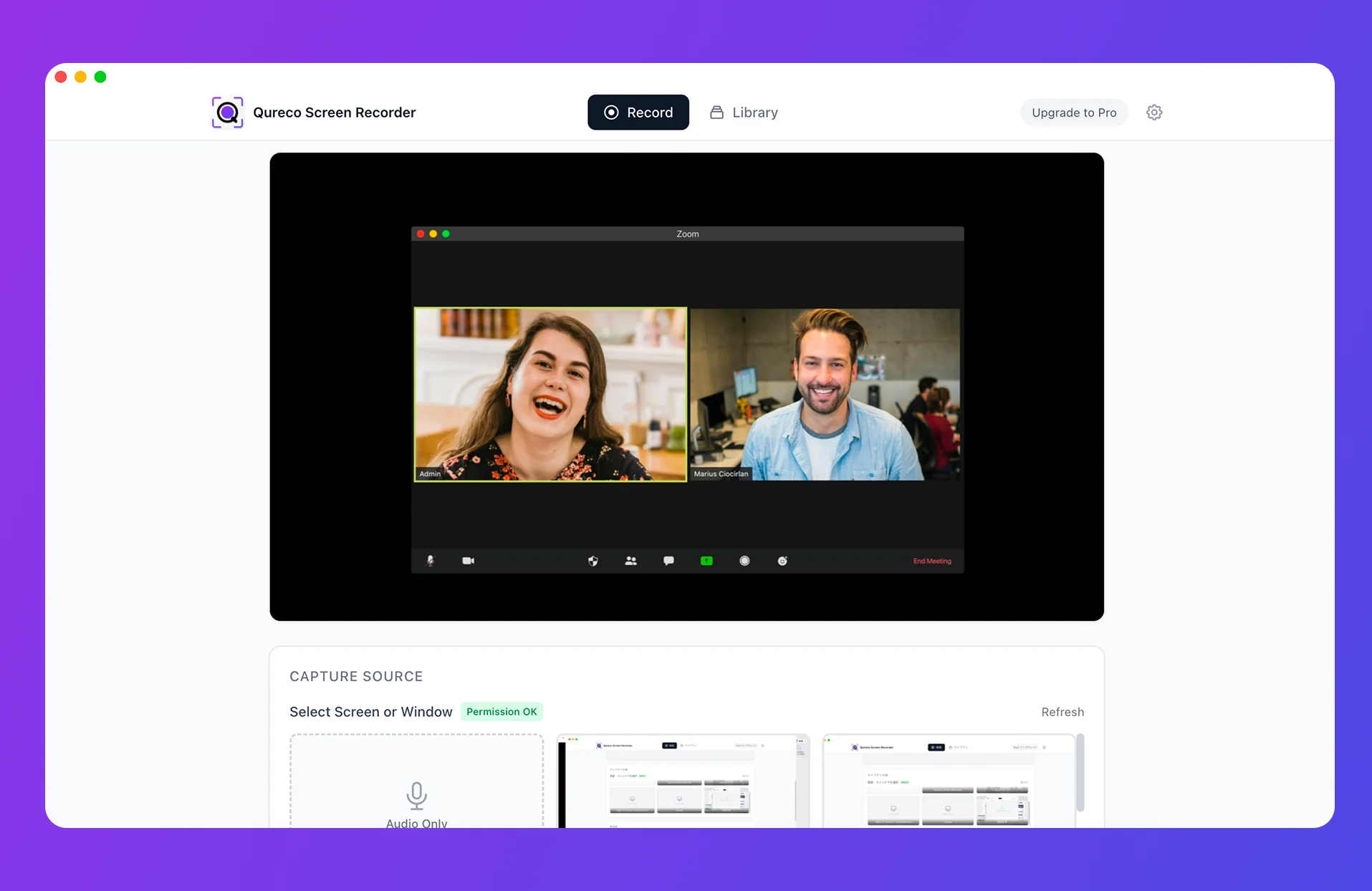
Recording on your own machine avoids the situation entirely
If you add nothing to the meeting and capture everything locally on your own computer, the participant list looks exactly as it always does. What the other side sees is an ordinary call.
On the Pro plan, an AI turns the recording into meeting notes and sends them to Notion, which makes it considerably easier to deliver on the "I'll send you notes" part of what you just promised. Pro is free for the first two weeks and does not ask for a credit card.
Frequently asked questions
Can someone see later that I recorded?
Zoom cloud recordings and Teams recordings live inside the organization's storage, and some organizations can audit who started a recording and when. OS-level screen recording happens outside the meeting platform, so no record of it exists on the platform side.
Is there a way to record without the host knowing?
Technically yes, but this article does not walk you through it, for the reasons above. If you have a genuine reason to keep a record, stating that reason is faster and rarely refused.
Do screenshots trigger a notification?
None of Zoom, Meet or Teams detects screenshots or notifies anyone about them. That said, shared material can be confidential or copyrighted, so being free to capture it is not the same as being free to circulate it.
How can I tell whether the other person is recording?
If they are using the platform's built-in recording, you will see the indicator on your own screen. No indicator means no in-app recording is running. It does not rule out OS-level recording, which cannot be detected.
Where do recordings get stored?
Zoom local recordings go to your own computer and cloud recordings to Zoom's servers. Meet recordings land in the organizer's Google Drive, and Teams recordings in OneDrive or SharePoint. If you record with an app on your own machine, you know exactly where the file is, which makes the "how will you handle it" question easy to answer. With Qureco, the free tier keeps recordings local and Pro adds automatic cloud backup.
They said no. How do I keep a record anyway?
Take notes during the call, then close with "let me confirm we're aligned" and read the decisions and next steps back out loud. Getting those spoken and agreed in the moment prevents most of the misunderstandings a recording would have caught.
Terms used in this article
| Term | Meaning |
|---|---|
| In-app recording | The recording feature built into Zoom, Meet or Teams. Using it displays an indicator to participants |
| Local recording | Saving the recording to your own computer. In Zoom, this still shows the indicator to participants |
| Cloud recording | Saving to the vendor's servers. Usually a paid-tier feature |
| OS screen recording | Capture built into the operating system, such as Shift+Command+5 on macOS. Not detectable by meeting platforms |
| Recording consent disclaimer | A Zoom setting that requires participants to explicitly agree before being recorded |
| Compliance recording | Automated recording required by regulation or company policy. Teams notifies organizers when it is active |
| Meeting bot | A program an AI notes tool sends into the call as a participant. It appears in the participant list |
Summary
- Zoom, Google Meet and Teams all display an indicator when you use their built-in recording. "Local recording is silent" is wrong
- OS-level screen recording is not displayed, but that is not a reason to record without saying so
- What you actually need is not knowledge of notification behavior. It is ten seconds covering purpose, use and handling
- If the hesitation was really about a bot appearing in the participant list, changing how you record removes it
Trade the minutes you spent frozen over the record button for ten seconds at the top of the call. You will end up with a lot more to show for the meeting.

Qureco Screen Recorder
Powerful screen recording app for Mac
Record meetings, let AI handle the notes, just read what arrives in Notion.
Try all features free for the first two weeks.