You want to roll out meeting recording and AI notes for your team. You raise it with IT, and the questions come back:
"Which server does that recording data live on?" "Are you recording the calls where partner technical details come up?"
This article maps the storage locations for the three major platforms, points out a structural risk most teams miss, and ends with a checklist you can take straight into an internal review.
The short answer: where each platform stores recordings
Recording built into a meeting platform saves to a fixed location. It is not something the user chooses.
| Platform | Where it goes | Notes |
|---|---|---|
| Zoom (local recording) | The recorder's own computer | Saved as MP4 |
| Zoom (cloud recording) | Zoom's servers | Paid licenses only, 5 GB to start |
| Google Meet | The organizer's My Drive, in a Meet Recordings folder | A subfolder is created per meeting |
| Microsoft Teams | SharePoint for channel meetings, OneDrive for everything else | Location depends on meeting type |
| Device side recording apps | User's choice of local or cloud | Varies by tool |
Who can open them
Access rights are the natural follow up question.
With Zoom cloud recordings, account owners and administrators control what hosts are allowed to do at an organizational level. They can enable, disable, and lock settings for sharing, automatic recording, and who is permitted to download. There are also options to require user authentication before viewing and to put a passcode on shared recordings.
That last part matters. Being able to say "administrators control this centrally" is often the single most useful fact when you are trying to get something approved.
The risk most teams miss: recordings in a personal drive
This is the part that slips past almost everyone.
What happens when the organizer leaves
Which means that when that person moves teams or leaves the company and their account is deprovisioned, the status of every meeting recorded under their name becomes an open question. Records you assumed were an organizational asset turn out to have been hanging off a personal account the whole time.
This is the kind of problem that surfaces two years after rollout, which is exactly why it is worth settling at the start.
Hitting a storage limit stops recording entirely
"We thought it was recording and it was not" traces back to this more often than you would expect. For meetings that genuinely matter, checking available capacity beforehand becomes part of the routine.
What to decide up front
Nothing elaborate is required. For meetings you intend to keep, pick one of these and you have covered most of the exposure:
- Standardize on a specific account as the organizer for recorded meetings
- Move recordings to a shared drive or another managed location after the fact
The second storage location: audio you hand to an AI notetaker
Audio may be sent to an external AI service for transcription and summarization. Your recording file can be sitting safely in your own Drive while the audio has passed through a completely different vendor.
Four things to verify
When evaluating an AI notetaker, confirm these:
- Is it stated explicitly that your input is not used for training? Look for a documented opt out
- Does data ownership remain with your company?
- Is there a defined process that deletes your data when you cancel?
- What is the vendor's liability if there is a breach?
Cloud based tools, and free tiers in particular, have been flagged for potentially reusing submitted audio and text as training data to improve model accuracy. If your meetings touch unreleased product plans or personnel evaluations, this is not a step you can skip.
Watch for "we may use this to improve our services"
It is a common phrase in terms of service, and on its own it tells you nothing about what is actually happening. Ask in writing whether that includes use as training data.
The decision rule is simple enough: choose services that either rule out training use explicitly, or provide a setting that lets you refuse it outright.
Sorting confidential meetings from the rest
Trying to apply one policy to every meeting means applying your strictest requirement everywhere, and that tends to collapse under its own weight.
Three tiers, three storage decisions
| Tier | Examples | Storage approach |
|---|---|---|
| General internal meetings | Standups, status updates, internal training | Cloud storage, centrally managed, is fine |
| Meetings with customer information | Sales calls, customer check ins | Limit retention period and access rights |
| Highly confidential meetings | Partner technical details, personnel reviews, legal | Keeping them on the device is a defensible choice |
Settle these three tiers first and the tool selection conversation gets dramatically easier.
Local storage as a real option
How you handle the third tier determines which tools remain viable.
Recording built into a meeting platform gives you no say in storage location. Meet puts it in the organizer's Drive, Teams in OneDrive or SharePoint, automatically. There is no way to say "this particular meeting stays on my machine."
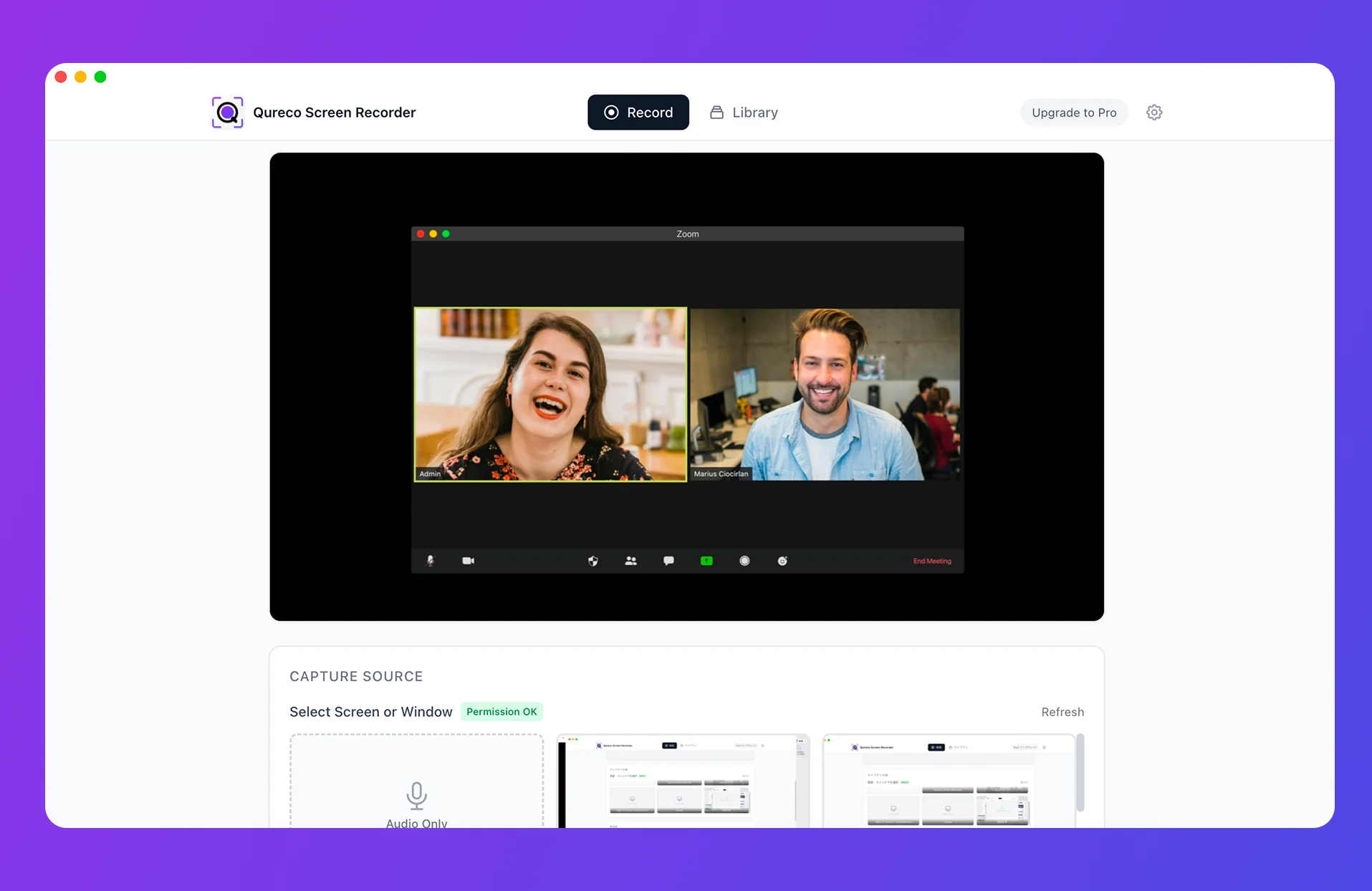
With Qureco, recordings in the free version are stored locally. The Pro plan adds automatic backup to the cloud, on AWS S3, along with AI generated meeting notes. The two modes can be used side by side depending on the meeting.
To be accurate about it: Pro's cloud storage is external cloud storage like any other. This is not a claim that one vendor is uniquely safe. You should weigh it on the same terms as anything else.
None of this means cloud storage is worse
Read this far and you might conclude local storage wins. It is not that simple.
Cloud storage brings controls that local storage cannot offer: centralized permission management, automatic deletion after a set period, authentication before viewing. None of that is achievable across files scattered on individual laptops.
The goal is not to declare a winner. It is to be in a position to choose per meeting.
A checklist for your internal review
These are the items IT or your leadership will typically want covered.
| Item | What to establish | Where to look |
|---|---|---|
| Storage location | Which vendor, which service, which region | Terms of service, admin console |
| Access rights | Who can view and download, who administers permissions | Admin console |
| Retention | How long data persists, whether auto deletion is available | Admin console settings |
| AI processing | Whether audio leaves your tenant, whether it trains models | Privacy policy, direct inquiry |
| Handover | What happens to data when someone leaves or transfers | An internal policy decision |
You do not have to complete every row. Set your bar by the most sensitive category of meeting you actually hold, and verify to that level.
Summary: decide which meetings go where, first
- Zoom stores locally or in your Zoom cloud, Meet stores in the organizer's My Drive, Teams uses OneDrive or SharePoint. Location is fixed per platform
- Recordings that land in a personal drive create problems at offboarding and when quota runs out
- Separately from the recording file, trace where AI notetaker audio goes. A documented training opt out is the thing to look for
- Sort meetings into three confidentiality tiers and make sure the top tier can stay local
- Cloud is not the risky option. Central administrative control is a genuine strength of it
Deciding which meetings belong where, before you decide on a tool, moves the internal conversation along faster than almost anything else. Start by sorting your own meetings into those three tiers.

Qureco Screen Recorder
Powerful screen recording app for Mac
Record meetings, let AI handle the notes, just read what arrives in Notion.
Try all features free for the first two weeks.
Frequently asked questions
No. Lost or stolen hardware, and data walking out at offboarding, are arguably harder to manage with local storage. Local makes sense when confidentiality is high, the audience is small, and you have device management under control.
It depends on your industry and the data involved. Personal data raises cross border transfer considerations, and some sectors have guidance requiring domestic storage. Check your own policies first, then ask the vendor which region holds your data.
It varies. For platform native recording, cloud recording is commonly restricted to paid licenses in the first place. Device side apps more often make local storage the free tier and cloud storage the paid one.
Glossary
| Term | Meaning |
|---|---|
| Local storage | Keeping recordings on your own computer, with no external server involved |
| Cloud storage | Keeping recordings on a provider's servers. Which provider changes the review considerations |
| Retention period | How long data is kept. Some services offer automatic deletion after a set interval |
| Opt out | A setting or request that prevents your input from being used to train AI models |
| Access rights | Who may view, edit, or download a file, and who administers those permissions |