You finish a 40 minute software walkthrough, play it back before exporting, and the voice is trailing the screen by the end. So you nudge the audio track earlier in your editor. Now the opening is right but the ending is worse. Pull it the other way and the ending locks in while the opening falls apart.
Screen recording sync problems come in two varieties, and they have almost nothing in common. This article shows you how to tell yours apart in about 30 seconds, how to rescue a file you cannot reshoot, and what to change so the next recording comes out clean.
Start here: constant offset or progressive drift?
Most people searching for a fix skip this step, which is why they end up reading advice that does not apply to them.
The 30 second test
| What you see | How it behaves | Type | Where the cause lives |
|---|---|---|---|
| Same gap all the way through | Audio sits a fixed amount early or late | Constant offset | Your playback setup, or the front of the capture chain |
| Opening is fine, gap widens later | Difference grows with running time | Progressive drift | The device setup at capture time |
If the first minute lines up but you are nearly a second out by the end, you have progressive drift. Shifting the whole track cannot fix it, because you are trying to correct a gap that keeps changing with a correction that never does.
If there is no audio at all, this is the wrong article
Constant offset: check playback before you touch the file
Are you listening on Bluetooth?
How much latency depends on the codec in use. Low latency codecs exist, but they only help when the sending device and the receiving device both support the same one. If your Mac supports it and your earbuds do not, the connection falls back to a standard codec.
Still off? Then correct it in your editor
If it is still out of sync on a wired connection, the file genuinely carries a fixed offset. Because this is the constant type, moving the entire audio track will line it up. That is exactly what separates it from drift.
To measure the gap, find a moment where a sound has a clear visual trigger. Keystrokes and mouse clicks work well as markers.
Progressive drift: two clocks running at slightly different speeds
This is the part that trips people up.
Why the gap keeps growing
Per second, the discrepancy is tiny. Over a long take, it compounds. In video production, mixed frame rate footage has been reported to drift roughly a second over 30 minutes. That is why a 40 minute recording feels fine until the last stretch.
Three setups that cause it on Mac
macOS will not record system audio on its own. The common workaround is installing a virtual audio driver such as BlackHole to create a path for the sound. It works, but it inserts a stage into the signal chain that was not there before, and every added stage is another opportunity for clock references to diverge.
If you bundled your microphone and system audio into a single aggregate device to capture both at once, this is prime territory for drift. You are forcing separate hardware clocks to act as one.
Sample rate is how many times per second audio gets measured. Mixing 44.1 kHz and 48 kHz forces conversion, and conversion invites drift.
How to check it in Audio MIDI Setup
Open Audio MIDI Setup, found in the Utilities folder inside Applications.
- Select the device you record with from the list on the left
- Check the sample rate in the Format field and set every device involved to 48 kHz
- If you use an aggregate device, select it and review its contents
- Choose one device as the clock source for that aggregate
- Enable Drift Correction on every device that is not the clock source
Steps 4 and 5 are the ones people miss. Without them, the bundled devices keep running on their own clocks, which is precisely the condition that produces drift.
Rescuing a recording you cannot reshoot
Now for the file you already have.
Drift needs stretching, not shifting
The math is straightforward. Take the gap at the end and divide it by the total running time. A one second gap at the end of a 40 minute recording is 1 divided by 2400, or about 0.04 percent. Adjust the audio clip's speed by that amount and, in principle, the whole file lines up.
Most editors can change speed while preserving pitch. At 0.04 percent, nobody will hear the difference.
Being honest about the limits
For a client deliverable, if something still feels off after correction, reshooting is sometimes the faster path. Worth saying plainly.
Recording so it does not drift next time
For progressive drift, changing how you capture beats fixing it afterward, because the cause is structural.
Shorten the capture chain
Install a virtual audio driver, bundle devices into an aggregate, hand that to a recording app. Every one of those stages is a place where clock references can diverge.
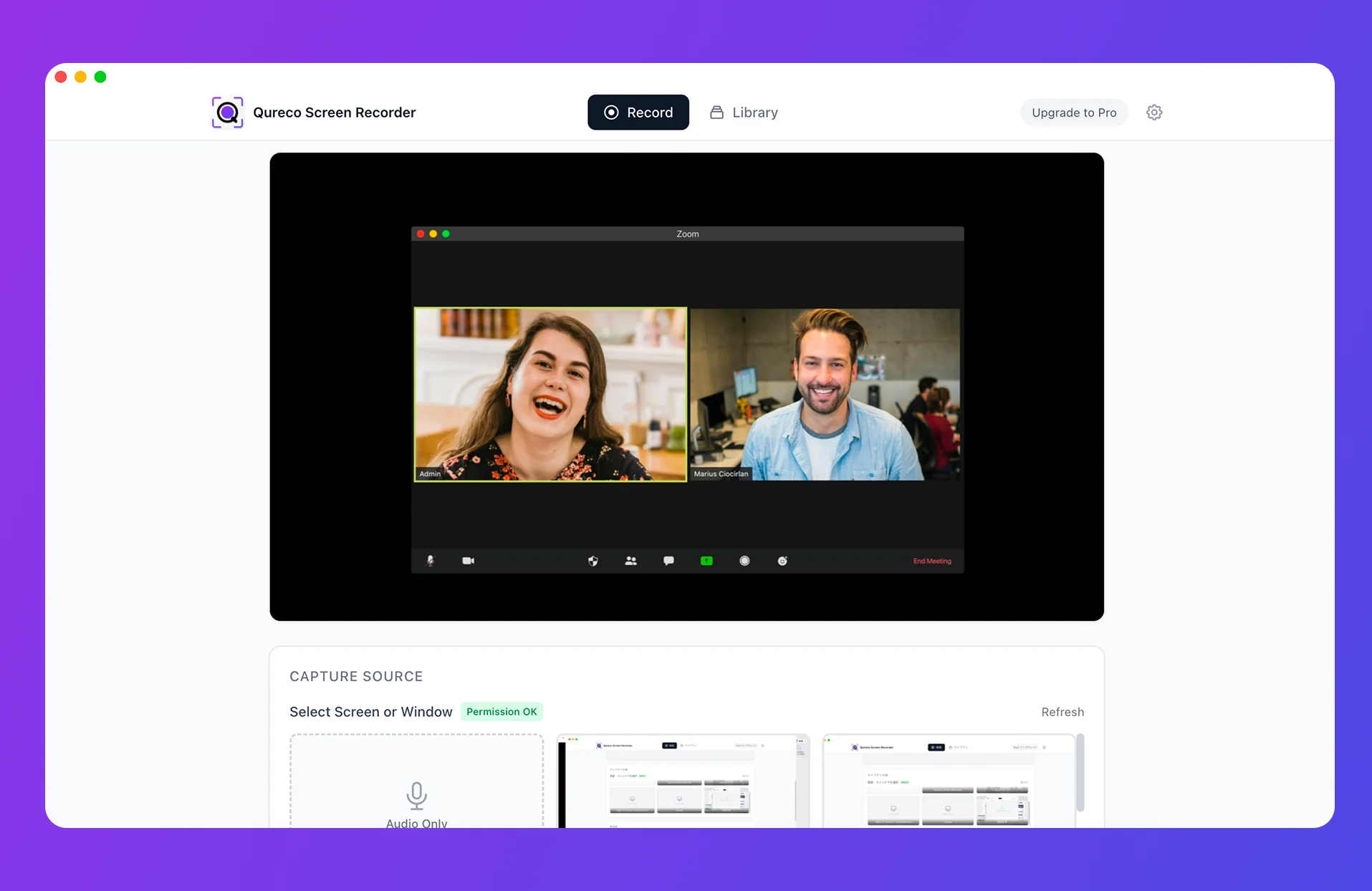
Qureco captures system audio without any virtual audio setup. You toggle microphone and system audio inside the app, so there is no aggregate device to build. Recording is free, with no time limit and no watermark.
One thing worth stating clearly: this is not a claim that sync problems become impossible. Shortening the capture chain removes one known cause. That is the honest scope of it.
Reduce CPU load
When your Mac cannot keep up during capture, frames get dropped, and missing frames break the relationship between picture and sound.
If your recorder lets you pick a resolution, dropping to 1080p or 720p makes a noticeable difference to system load.
Go wired while recording
Bluetooth latency also affects monitoring during capture. If something feels slightly off while you record, you cannot tell whether the file is drifting or your headphones are lagging.
Switching to a wired connection for recording sessions is unglamorous, but it removes a variable that clouds your judgment.
Summary: the way it drifts tells you what to do
- Same gap throughout (constant offset): suspect Bluetooth first and replay on a wired connection. If it is genuinely in the file, a uniform shift in your editor fixes it
- Gap widens over time (progressive drift): caused by your capture device setup. In Audio MIDI Setup, set everything to 48 kHz and configure the clock source and Drift Correction on your aggregate device
- For a file you already have: drift needs audio stretching. Your correction rate is the gap at the end divided by total running time
- Going forward: avoid stacking virtual audio drivers and aggregate devices. A shorter capture chain is the most reliable fix
Sync problems are far quicker to prevent than to repair. Start by working out which type you have.

Qureco Screen Recorder
Powerful screen recording app for Mac
Record meetings, let AI handle the notes, just read what arrives in Notion.
Try all features free for the first two weeks.
Frequently asked questions
Yes. The issue is rarely QuickTime itself. If you configured a virtual audio driver to capture system audio, that setup is what produces the drift. Microphone only recordings are much less prone to it.
Not for progressive drift, because the cause is baked into the recorded file. That said, an editor with fine grained speed control makes the correction work easier.
The microphone alone rarely causes it. Problems show up when an external microphone and system audio are bundled into an aggregate device. In that case, check your clock source and Drift Correction settings.
Your export frame rate probably differs from your capture frame rate. This shows up most often when capture used variable frame rate and export is fixed. Match the export settings to what you recorded.
Glossary
| Term | Meaning |
|---|---|
| Drift | The widening gap between audio and video that develops when devices run on internal clocks with slightly different speeds |
| Sample rate | How many times per second audio is measured. Commonly 44.1 kHz or 48 kHz. Mismatches force conversion |
| Aggregate device | A macOS feature that combines multiple audio devices into one. Requires a designated clock source and Drift Correction settings |
| Virtual audio device | A software only driver that creates a path for audio, such as BlackHole. Used on macOS to capture system audio |
| Variable frame rate | Capture where the frame rate fluctuates rather than holding steady. Can cause sync problems depending on how an editor handles it |